Tree Burial and Tree Pods: Can a Tree Grow From Ashes?
How tree burial and tree pod urns work, whether a tree can grow from cremated remains, what kits cost, where you can plant and the alternatives.
- Updated
- 4 min read
- 6 sources checked
- By Matt Morgan
The short answer
Tree burial usually means planting a biodegradable urn of cremated remains with a tree or seed. Cremated remains are high in sodium and pH, which can harm plants, and the Green Burial Council calls the chance of a tree reaching maturity beside such a pod unproven. Kits such as the Bios Urn and Living Urn cost about $135 to $140 and use a soil mix to help.
Key takeaways
- Cremated remains have very high pH and sodium, so planting a tree directly in raw ashes can harm it; the Green Burial Council calls success with tree pods unproven.
- Bios Urn lists its urn at $140 and The Living Urn lists its system at $135; both are for cremated remains, not whole-body burial.
- The full-body Capsula Mundi pod is still in development, according to its makers; only the small urn for ashes is for sale.
- You can usually plant on your own private property, but public land and cemeteries need permission, and local rules vary.
On this page
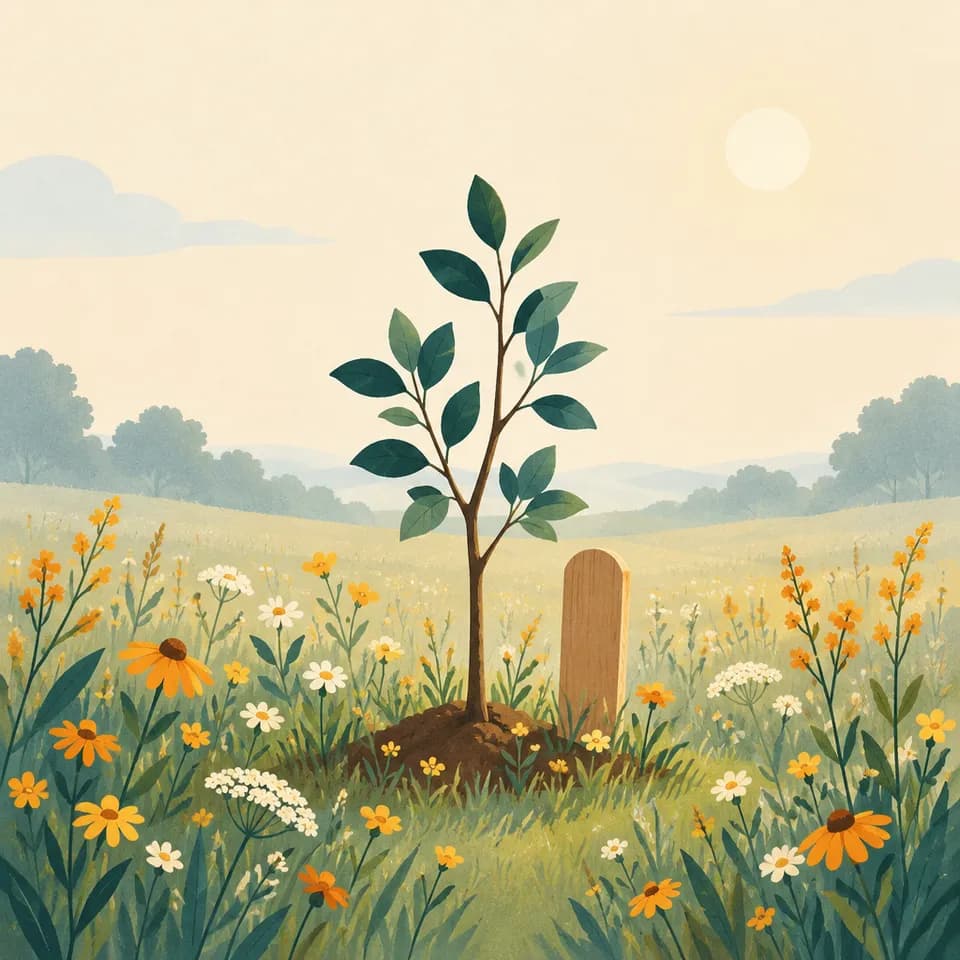
Tree burial usually means burying cremated remains in a biodegradable urn with a tree or seed planted on top. It can be a meaningful memorial, but growing a tree from ashes is harder than the marketing suggests, because cremated remains are high in sodium and pH. The Green Burial Council (GBC) says the chance of a tree reaching maturity next to a tree pod is unproven.
What is tree burial?
People use the phrase in three ways:
- Tree pod or bio urn. A biodegradable urn holds ashes and is planted with a seed or sapling. Bios Urn, The Living Urn and Capsula Mundi all make versions.
- Memorial tree at a cemetery or forest. The ashes are buried at a site that plants a tree as the marker. See memorial trees.
- Green burial with a tree marker. A body is buried unembalmed in a natural or conservation cemetery, and a native tree or shrub replaces a headstone. The GBC lists natural plantings among the common grave markers.
The "tree burial of a whole body in a pod" idea is not something you can buy yet.
Can a tree grow from cremated remains?
Not reliably. Human ashes are not fertilizer. The GBC says cremated remains have extremely high pH and sodium levels that are far too high for most plants. The Conservation Burial Alliance puts the pH at about 11.8 and says it can harm vegetation above and below ground.
The GBC is openly skeptical about the pod products. Of the egg-shaped urn design, it says the chances a tree will grow to maturity close to the capsule are unproven.
The kits try to solve this with a soil mix and growing medium around the ashes. Bios Urn says its system mixes a coco-peat and paper disc and a vermiculture soil mix with the remains. The Conservation Burial Alliance notes that some sites bury ashes with proven soil amendments and a process designed to protect roots. Bios Urn also says you can use all the ashes or only a symbolic portion, which is one way to reduce the load on the tree.
If the tree matters as much as the burial, consider planting a memorial tree separately from the ashes, for example beside the grave or urn site.
Which tree pods and urns can you buy?
| Product | What it is | Price or status |
|---|---|---|
| Bios Urn | Two-part biodegradable urn: ashes below, seed above | $140 listed on its FAQ page; pet version $99 |
| The Living Urn | Planting system with a biodegradable urn, in kit form with or without a tree | From $135 for the urn system; packages with a tree cost more |
| Capsula Mundi | Egg-shaped biodegradable urn for ashes | Available through its shop; the body pod is in development, "not ready for the market" |
Bios Urn says it has sold more than 100,000 urns and that complaints about non-growth are rare. The Living Urn says its kits come with a tree that is 2 to 4 feet tall and offers memorial forest sites through partner cemeteries. Those are company claims, and neither shows independent growth data.
Where can you plant a tree urn?
- Your own property. Bios Urn says its urn can be legally planted on any private property. Laws on burying ashes vary by state and town, so check zoning and deed rules first. See burying ashes in a garden.
- A cemetery or memorial forest. The Living Urn partners with memorial parks and cemeteries, and some traditional cemeteries now allow tree urns. Ask about fees, markers and what happens if the tree dies.
- Public land. You generally need permission first. Bios Urn advises getting prior authorization for public spaces. Our guides on scattering ashes and what to do with ashes cover the rules.
If you rent or may move, think about what happens to the tree later.
How much does tree burial cost?
The kit is usually the smaller cost. Current list prices are $135 to $140 for the urn systems above. On top of that you may pay for:
- cremation or aquamation, which varies by provider
- a tree or sapling, where the kit doesn't include one
- a site, if you use a cemetery or memorial forest; the Funeral Consumers Alliance says green cemeteries charge $200 to $1,000 for burying cremated remains
If you want a whole-body burial under a tree, see conservation cemeteries, where the FCA says a grave site and interment run $1,000 to $4,000 for a body.
How can you improve the odds?
- Choose a native species. Bios Urn says to choose a native or locally common tree.
- Use a sapling if you can. Bios Urn says a seedling or sprout works in place of a seed.
- Use part of the ashes. Bios Urn says a symbolic portion is an option.
- Ask the maker how the kit handles pH and sodium, and ask for evidence beyond customer numbers.
- Plan aftercare. A new tree needs watering and protection like any other, and a GPS pin or plaque helps you find the spot later.
For other ways to keep ashes, see biodegradable urns and memorial gardens for ashes.
What to do next
- Decide whether you want the ashes or the tree to be the focus.
- Check your local rules and the property's permission before planting.
- Ask any seller about their growth evidence, refunds and replacements before you pay.
Frequently asked questions
Can a tree grow from human ashes?
What is a tree pod burial?
Can you be buried in a tree pod without being cremated?
Is it legal to plant a tree urn in my yard?
What if the tree dies?
Sources we checked
- 1.Green Burial FAQ · Green Burial Council
- 2.Burying Cremated Remains · Conservation Burial Alliance
- 3.Bios Urn FAQ · Bios Urn
- 4.The Living Urn · The Living Urn
- 5.Capsula Mundi · Capsula Mundi
- 6.Green Burial and Other Environmentally Friendly Choices · Funeral Consumers Alliance
Written by Matt Morgan, Founder and editor
Matt founded End of Life Tools and researches every guide from primary sources such as the FTC, SSA, VA, IRS and state law. He is not a licensed professional, and guides are general information, not advice.
Checked against 6 official and industry sources · Updated Sep 30, 2026How we write and check guides
Please note: General information, not legal, financial or medical advice. Check the details with the relevant agency or a qualified professional. Rules and prices change, so confirm anything important with the organization concerned. If you spot something out of date, tell us.
Related guides
More in Green & Alternative OptionsFree printable
Every task after a death, in the order you'll need it
Two pages to print, share with family and tick off as you go.